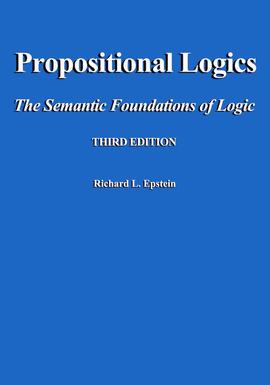
Propositional Logics presents the history, philosophy, and mathematics of the major systems of propositional logic. Classical logic, modal logics, many-valued logics, intuitionism, paraconsistent logics, and dependent implication are examined in separate chapters. Each begins with a motivation in the originators' own terms, followed by the standard formal semantics, syntax, and completeness theorem. The chapters on the various logics are largely self-contained so that the book can be used as a reference. An appendix summarizes the formal semantics and axiomatizations of the logics. The view that unifies the exposition is that propositional logics comprise a spectrum. As the aspect of propositions under consideration varies, the logic varies. Each logic is shown to fall naturally within a general framework for semantics. A theory of translations between logics is presented that allows for further comparisons, and necessary conditions are given for a translation to preserve meaning. For this third edition the material has been re-organized to make the text easier to study, and a new section on paraconsistent l


 -5%
-5%
 -5%
-5%
 -5%
-5%
 -5%
-5%
 -5%
-5%


 -5%
-5%
 -5%
-5%

 -5%
-5%