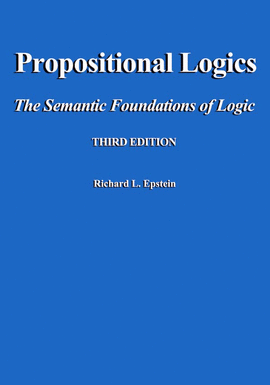
? Intended for a course for beginning students in philosophy, mathematics, linguistics, or computer science. ? Motivation for each formal concept and each step in building a formal logic in terms of formalizing reasoning. Provides a conception of formal logic and not just a collection of results. Summaries at important junctures in the book keep students aware of what they're doing and where they're going. ? Hundreds of exercises that teach. ? Criteria of formalization with many examples of formalizing ordinary language reasoning in an example-analysis format. ? A complete course: syntax, semantics, and completeness theorems for classical propositional logic and classical predicate logic, and syntax and semantics for second-order classical predicate logic. 1 ÿPropositions, Inferences, and Formal Logic 2 ÿClassical Propositional Logic 3 ÿThe Internal Structure of Propositions 4 ÿA Formal Language for Predicate Logic 5 ÿSemantics for Classical Predicate Logic 6 ÿAn Axiom System for Classical Predicate Logic Summary of Chapters 3?6 7 ÿFormalizing in Classical Predicate Logic 8 ÿIdentity 9 ÿFormalizing with the


 -5%
-5%
 -5%
-5%
 -5%
-5%
 -5%
-5%
 -5%
-5%


 -5%
-5%
 -5%
-5%

 -5%
-5%